Puzzle Page - Daily Puzzles!
- 4.3
- Rating
- 5.00M
- Installs
- Free
- Price

 Analysis by App-foxy
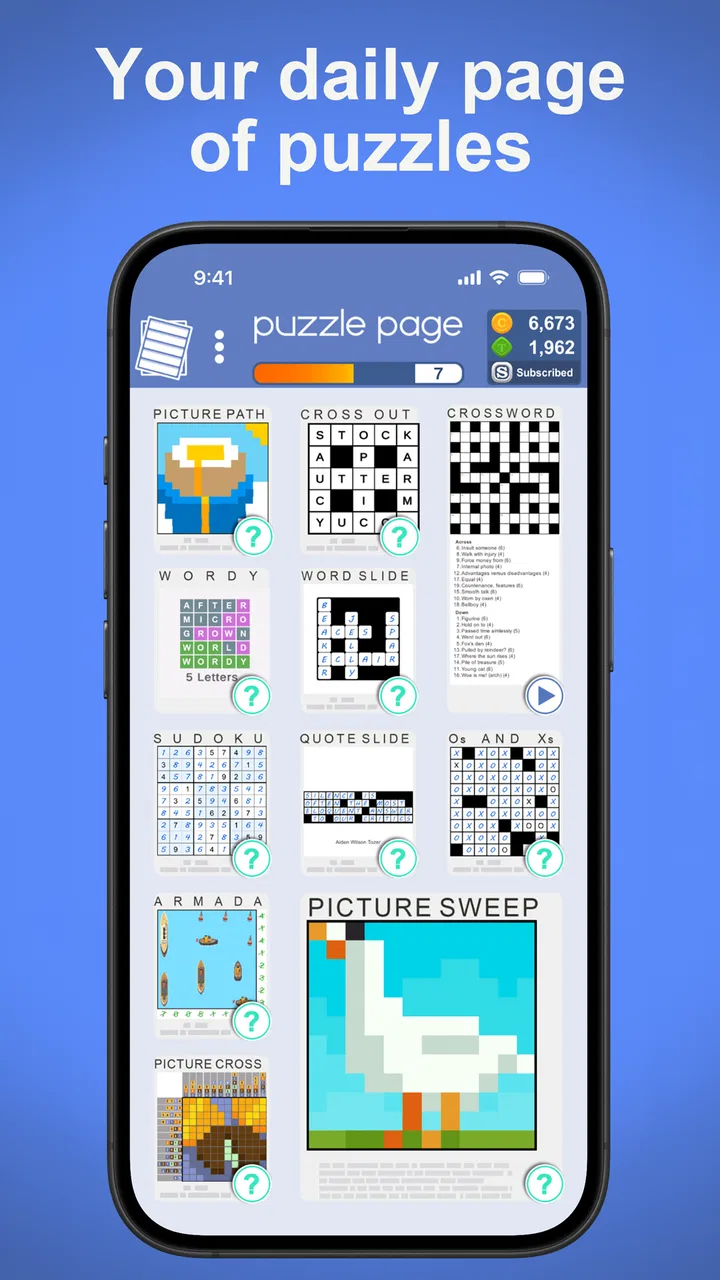
I opened Puzzle Page - Daily Puzzles! expecting a quick word game and found something broader: a rotating collection of word, logic, and number puzzles gathered into one daily routine. That variety is the main reason I would recommend it to someone who wants a little mental exercise without committing to a long, complicated game. I can choose a familiar style when I am tired, or switch to a different kind of challenge when I want something that demands more attention.
The important thing to understand before installing it is that this is not one single puzzle format with a long campaign. It is a puzzle page in the literal sense: a place to browse and play different daily challenges. That makes the game approachable, but it also means the experience depends on whether you enjoy sampling several puzzle types rather than mastering one tightly focused system.
What the first session feels like
The game comes from puzzling.com and is listed as a free puzzle game for everyone. It has built a substantial audience, with an average rating of 4.3 from around 76 thousand ratings and more than 5 million installs. Those figures suggest that its appeal is easy to understand: it offers short activities that can fit into spare moments, while still giving players enough variety to return regularly.
You May Also Like

 Blood Strike: 2.5 Anniversary
Blood Strike’s Loadouts Turn Every Drop Into a Tactical Gamble
A close look at Blood Strike’s custom loadouts: how fast access to signature weapons reshapes its battle royale rhythm, rewards preparation, and narrows the gap between fights.

 Pandora - Music & Podcasts
Pandora’s Music Is Easy to Start, but Harder to Recover
Pandora’s strength is its low-effort path from a seed to a station. Its weak spot is how much confidence it asks you to place in connection, setup, and quiet recovery.

 8 Ball Pool
 Is Built on Rivalries, Rematches, and Routine
A close look at the rivalries, rematches, shared routines, and unanswered safety questions that turn a quick pool match into a persistent mobile community.

 Samsung Music
’s Quiet Strength Is Playing What You Already Own
Its reach comes less from spectacle than from dependable access to a personal library. That simplicity is both the app’s strongest retention engine and its ceiling.

 AccuWeather: Weather Radar
AccuWeather Review: A Quick, Clear Forecast for Everyday Decisions
For everyday plans, the best forecast is the one you can understand quickly. AccuWeather makes rain timing, radar, and local conditions easy to act on, with a few trade-offs.

 Hill Climb Racing
Why Hill Climb Racing Still Turns Crashes Into One More Run
A tiny car, a bumpy hill and one more upgrade: Hill Climb Racing keeps resurfacing because its simple chaos makes every near-miss feel personal.
More From Our News Desk



My first useful piece of advice is not to treat the opening screen like a test. You do not need to know every puzzle style before starting. Browse the available choices, pick the one whose instructions look clearest, and give yourself permission to stop after one round. The best first experience comes from finding a comfortable entry point, not from trying to complete everything immediately.
Word puzzles are a natural starting place if you enjoy vocabulary and pattern recognition. Number puzzles suit players who prefer orderly steps and visible logic. Logic puzzles can feel more open-ended because the solution may depend on noticing relationships rather than simply calculating an answer. Having all three families together is convenient, although it also creates a small learning curve: a strategy that works beautifully in one puzzle may be useless in the next.
The game is free to download, but it includes in-app purchases ranging from $2.99 to $49.99 per item. I would approach that calmly. You can begin without paying, learn which puzzle types you actually enjoy, and decide later whether any optional purchase is worthwhile for your habits. That is a better approach than assuming that every part of the experience needs to be unlocked from the start.
Getting comfortable after installation
The current version is 7.8.1, and the game requires Android 8.0 or later. On a compatible device, the sensible setup is simple: install it, open the puzzle selection, and look for the challenge whose instructions make immediate sense. I would avoid judging the whole game from the first puzzle you try, because a collection like this can feel very different depending on whether you begin with words, numbers, or deduction.
For a first-time player, the most useful habit is to read the objective before touching the board. Many puzzle mistakes come from solving the wrong problem quickly. Ask yourself what counts as a completed answer, whether the order of entries matters, and whether the puzzle is asking for a single solution or a set of related answers. Spending a few seconds on that orientation makes the first successful action feel much more attainable.
I also recommend starting with a short session rather than trying to clear every available challenge. A daily puzzle collection works best when it becomes a repeatable pause in your day. I might open it while waiting for an appointment, complete one word challenge, and leave before the experience turns into a chore. That rhythm is more sustainable than forcing a long session when my attention is already gone.
How to reach the first meaningful success
My preferred first-session workflow is deliberately modest. I choose one puzzle, scan the entire layout, identify the easiest entry, and make a single confident move. In a word puzzle, that might mean filling an answer suggested by several obvious letters. In a number puzzle, it could be locating the row or group with the fewest possibilities. In a logic challenge, I look for a direct relationship before making any assumption.
This approach matters because early success teaches you the game’s language. You learn how the board responds, how completed entries are represented, and how much information is available at a glance. Instead of tapping randomly until something changes, you start building a repeatable solving process. The strongest beginner strategy is to reduce uncertainty before making a move.
When I get stuck, I do not immediately conclude that the puzzle is too difficult. I first check whether I have overlooked a simple constraint. With number puzzles, I review the available values and spaces. With word puzzles, I reconsider whether I am relying on a familiar word that does not actually fit. With logic puzzles, I separate facts from guesses. That small reset often reveals that the obstacle was not difficulty but premature commitment.
A realistic everyday use case is a short break between tasks. Suppose I have ten minutes before a meeting. I can open the game, choose a puzzle that matches my energy, and work until the meeting begins. If I am mentally tired, a word challenge may feel more welcoming than a dense logic problem. If I want to wake up my concentration, a number or deduction puzzle may be more useful. The collection gives me that choice without requiring a separate app for every mood.
Where new players can become confused
The biggest possible confusion is expecting every puzzle to follow the same rules. They do not. The game groups different kinds of thinking together, so the interface may feel familiar while the solving method changes. A player who normally relies on trial and error in word games may find that approach unhelpful in a logic puzzle, where recording what is definitely true is more effective.
Another point of friction is the difference between being busy and being productive. Because the game offers multiple challenges, it can be tempting to jump from one unfinished puzzle to another. I found it more satisfying to finish one small task before browsing again. Completing a single puzzle gives the session a clear endpoint, while constantly switching can make the collection feel scattered.
It is also worth remembering that a daily format is not automatically a competitive format. If you enjoy tracking detailed performance, chasing rankings, or building a large character-based progression system, this may feel too restrained. Its value is in accessible puzzle practice and variety, not in creating a dramatic adventure around every answer.
Players should also think about how they feel about optional spending. The free entry point is helpful, but the presence of purchases means the game is not the same as a completely pay-free offline puzzle book. I would keep an eye on the purchase prompts and decide in advance whether I want to spend anything. That simple boundary prevents a casual break from becoming an unplanned expense.
Small techniques that make the collection better
One useful technique is to match puzzle type to attention level instead of choosing randomly. When I have only a few quiet minutes, I select a format where the goal is immediately visible. When I have more patience, I choose a logic challenge and allow myself time to test relationships carefully. This turns variety into a practical feature rather than just a larger menu.
A second technique is to use mistakes as information. In a number puzzle, an incorrect placement can show which assumption was too broad. In a word puzzle, a failed guess may reveal that the clue or pattern needs to be read differently. Rather than wiping out all progress mentally, I treat each error as a reason to narrow the next move. That mindset is especially helpful for beginners who might otherwise feel that one wrong answer ruins the session.
A third useful habit is to stop at a natural point. Daily puzzle games can be relaxing, but they can also become repetitive if I keep going after my concentration has faded. Ending after a completed challenge leaves me with a sense of progress and makes it easier to return the next day. For this particular game, moderation improves the experience because the appeal comes from a steady stream of small challenges rather than one enormous objective.
There is also a practical trade-off in having several puzzle families under one roof. You save storage space and avoid switching between separate apps, but you may not get the deepest version of any one genre. A dedicated crossword app may be better for someone who wants an extensive word-focused routine. A dedicated Sudoku or logic title may offer more specialized tools to a player who already knows exactly what they want. Puzzle Page is stronger when variety and convenience matter more than specialization.
Who will enjoy it, and who should skip it
I think this game is a good fit for casual players who want something they can open without preparation. It also suits families looking for age-appropriate puzzle entertainment, since the content rating is Everyone. People who enjoy moving between vocabulary, reasoning, and arithmetic will get more from it than players who want one carefully developed puzzle mechanic.
It can be useful for commuters, students taking a short mental break, and adults who want a screen activity that asks for attention rather than passive scrolling. I would not describe it as an educational course, but solving different puzzle styles can encourage careful reading, pattern recognition, and structured thinking. The benefit comes from engaging with the challenges, not from expecting the app to teach a formal lesson.
I would skip it if my priority were a large story, elaborate visuals, character progression, or a competitive multiplayer experience. It is also not my first choice when I want a single puzzle type with advanced customization. Someone who dislikes daily routines may find the format less compelling, while a player who enjoys collecting small challenges will probably appreciate the changing pace.
The rating and audience size make it easier to recommend as a low-risk starting point, but they do not remove the need to check personal preferences. A 4.3 average indicates broadly positive reception, not a promise that every puzzle style will suit every player. I would install it for variety, not because I expect every challenge to be equally enjoyable.
What to do after the first session
After completing the first puzzle, I would spend a little time trying one different category rather than immediately repeating the same format. That comparison tells you what the app can offer personally. If word puzzles feel natural but logic puzzles feel rewarding after a slower start, you may want to alternate them. If only one category appeals to you, that is useful information too: it may point you toward a more specialized alternative.
For a steady routine, choose a time of day when a short pause is realistic. Morning players may prefer number puzzles as a warm-up, while evening players may want a gentler word challenge. The exact schedule is less important than keeping the session small enough to remain enjoyable. I would aim for consistency rather than completion of everything shown on the page.
If you are considering an in-app purchase, wait until you understand your actual usage. Play enough free content to know whether you return for the puzzles themselves or simply enjoy the novelty of installation day. The available purchase range, from $2.99 to $49.99 per item, makes that pause especially sensible. A purchase should solve a need you have identified, not pressure you into exploring content you may never use.
One final point is that the game has been available since February 28, 2018, so it is not a brand-new experiment. Its continued presence and broad install base make it feel like an established option in the daily puzzle space. That does not make it perfect, but it does make the basic concept easy to trust: open the page, choose a challenge, solve at your own pace, and return when you want another short exercise.
Overall, Puzzle Page - Daily Puzzles! works best as a flexible pocket puzzle shelf. I like that I can move from words to numbers to logic without changing apps, and I appreciate that the first successful session can be as short as one completed challenge. Its limitations are equally clear: players seeking deep specialization, story-driven progression, or a completely purchase-free experience may be happier elsewhere. For a first-time user who wants approachable daily variety, however, I would start with one easy-looking puzzle, learn its rules carefully, and let the collection earn a place in my routine one successful solve at a time.
FAQs for Puzzle Page - Daily Puzzles!
01What is Puzzle Page - Daily Puzzles!?
Puzzle Page - Daily Puzzles! is a collection of bite-sized newspaper-style puzzles designed for daily play. Instead of focusing on one game type, it offers several formats, such as crosswords, word searches, number puzzles, logic challenges, and other rotating activities. Each puzzle is usually quick to start, making the app suitable for short breaks, commuting, or anyone who enjoys exercising their vocabulary, memory, and problem-solving skills.
02What types of puzzles are included in the app?
The app includes a broad selection of classic puzzle formats rather than a single repeated challenge. Depending on the available issue or content pack, you may encounter crosswords, codewords, word searches, sudoku-style number puzzles, picture or logic puzzles, quizzes, and other brain-training activities. The variety is one of its main strengths, although the exact selection can change as new daily pages and puzzle collections are released.
03Can I play Puzzle Page - Daily Puzzles! offline?
Many puzzles can be played without a continuous internet connection once the relevant daily content has been downloaded to your device. However, an internet connection may still be needed to download new puzzle pages, synchronize progress, display certain advertisements, restore purchases, or access online features. If you plan to play while traveling, it is best to open the app and download the latest available content before going offline.
04Is Puzzle Page - Daily Puzzles! free to download and use?
Puzzle Page - Daily Puzzles! can generally be downloaded at no initial cost, but access to all content may depend on advertising, subscriptions, or optional in-app purchases. Free users may receive a selection of puzzles or limited access to newer pages, while premium options can remove advertisements or unlock additional material. Before subscribing, review the price, billing frequency, trial conditions, and cancellation rules shown in your app store.
05Is Puzzle Page - Daily Puzzles! suitable for beginners and children?
The app is approachable for beginners because many puzzles provide familiar rules, clear instructions, hints, and adjustable difficulty or multiple challenge levels. It can also be enjoyable for older children, but suitability depends on the individual puzzle, reading ability, and any advertising or purchase options enabled on the device. Parents should review the content and configure app-store purchase restrictions before allowing younger users to play independently.
Pros
- Offers several puzzle types in one app
- including crosswords
- sudoku
- and word games.
- Daily challenges provide fresh content and encourage a consistent solving routine.
- Difficulty levels suit both casual players and experienced puzzle fans.
- Clean interface makes puzzles easy to read and navigate on mobile screens.
- Progress tracking helps you monitor completed puzzles and personal performance.
Cons
- Some puzzles and features may require a paid subscription or in-app purchase.
- The number of free puzzles can feel limited for frequent daily players.
- Ads may interrupt gameplay unless you upgrade to a premium plan.
- Certain puzzles are less comfortable to solve on smaller phone displays.
- An internet connection may be needed to access new content and updates.

Puzzle Page - Daily Puzzles!
Gallery